Our Sarasota location has moved! Visit us at 202 North Rhodes Avenue, Unit 104, Sarasota, FL 34237.
Recovering speech after a stroke can feel like learning a new language all over again. Words may slur, sentences might come out jumbled, or familiar sounds might suddenly feel foreign. These challenges, common for many stroke survivors, can be frustrating, even discouraging. But here’s the silver lining: with consistent practice and the right guidance, clear and confident speech is achievable.
Early intervention and daily exercises can make a real difference. Just like physical therapy strengthens your body, speech therapy rebuilds your communication skills, one word at a time.
A stroke can disrupt the brain’s language centers, leading to conditions like:
Aphasia: Difficulty understanding or producing words.
Dysarthria: Weak or uncoordinated muscles making speech slurred.
Apraxia of Speech: Trouble planning and coordinating the mouth movements for speech.
Think of it this way: your brain’s “speech wiring” has been temporarily disrupted. Speech therapy after stroke acts like a guide, helping those connections rewire and regain function.
A speech-language pathologist (SLP) is like a personal coach for your speech. They evaluate your unique challenges and create a tailored plan, combining exercises, strategies, and feedback.
While self-practice is valuable, guided therapy accelerates progress. And remember: even if months have passed since a stroke, improvement is possible. Consistency, patience, and the right exercises are your strongest allies.
Here are exercises that can bring measurable improvement, and confidence back to your speech:
Diaphragmatic breathing: Take deep belly-breaths to support voice projection.
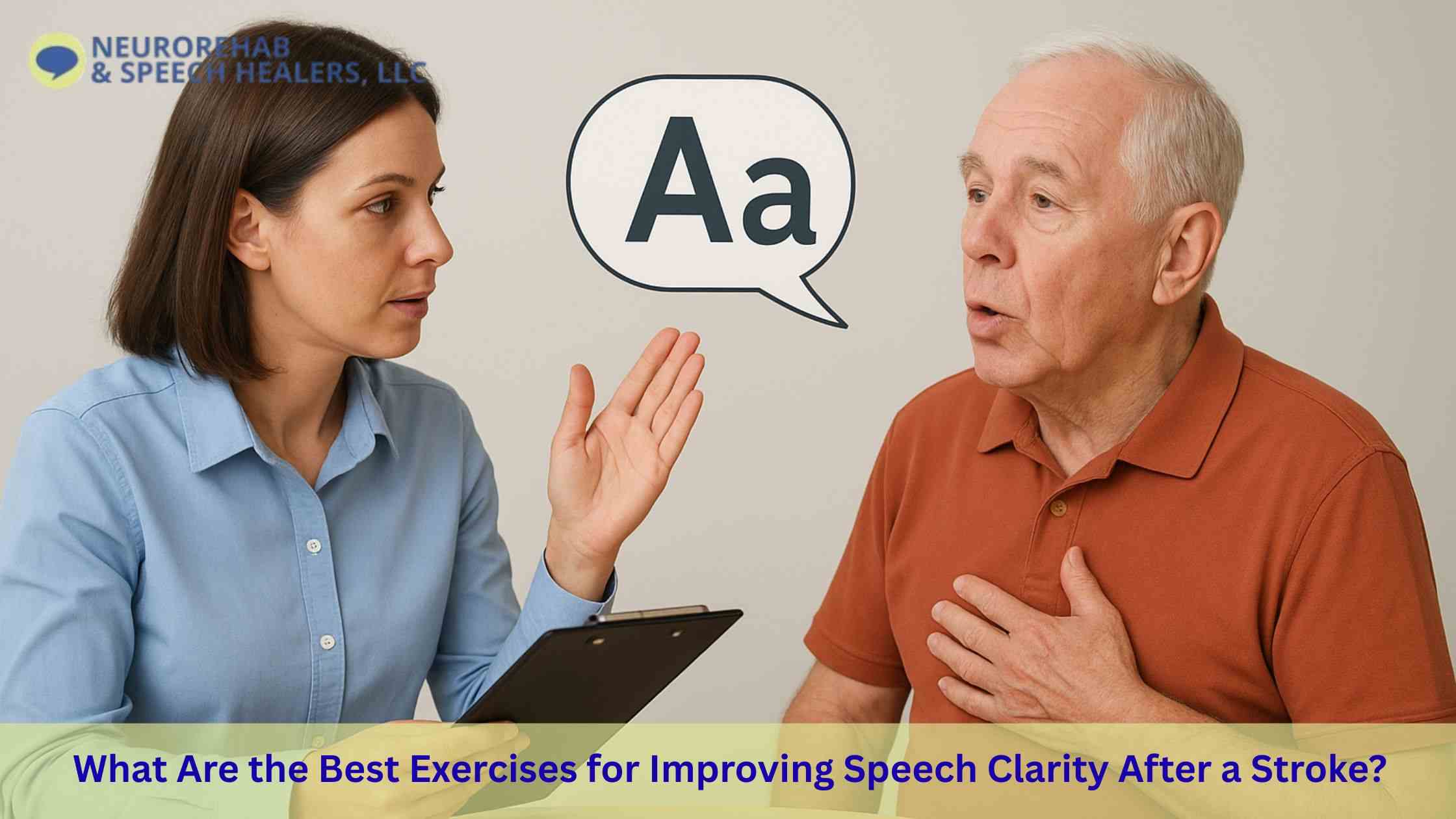
Prolonged vowel sounds: Say “ah” or “ee” slowly; it strengthens vocal muscles and improves control.
Tongue twisters: Start slow with phrases like “red lorry, yellow lorry.” Gradually speed up to improve precision.
Targeted consonants: Focus on sounds like p, b, t, d, k, and g. Repetition builds clarity.
Repetition drills: Begin with simple words, then build to short sentences.
Read aloud: Children’s books, poems, or simple articles help retrain speech patterns while making practice enjoyable.
Lip exercises: Pucker, smile, and hold sounds to strengthen lips.
Tongue mobility: Move the tongue side to side and up and down to improve flexibility and control.
Object naming: Name things around your home to sharpen word recall.
Conversational practice: Speak with family or friends daily. Short conversations matter more than long ones.
Memory tools: Apps, flashcards, or word games can make practice interactive and fun.
Consistency is more powerful than duration. Daily 10–15 minute sessions often outperform longer, irregular practice. Consider:
Recording your speech and tracking progress.
Reading aloud to practice flow and rhythm.
Using a mirror to check mouth movements.
Even small, daily efforts compound into real improvement over weeks and months.
Caregivers and family members play a vital role. Here’s how to help:
Celebrate communication attempts, don’t focus only on mistakes.
Speak slowly and clearly.
Encourage practice but avoid pressuring the stroke survivor.
Make exercises a positive, supportive routine.
Your encouragement is as important as the exercises themselves.
If speech difficulties persist, worsen, or cause significant frustration, it’s essential to consult a speech-language pathologist (SLP). Professional assessment can identify underlying issues, guide targeted therapy, and introduce strategies to improve clarity, fluency, and confidence. Ongoing therapy ensures steady progress, addresses subtle challenges, and provides structured support that self-practice alone may not achieve, helping patients regain effective and natural communication.
Regaining speech after a stroke is a gradual journey, but every effort counts. Consistent practice, professional guidance, and patient support can rebuild clarity, confidence, and independence in communication. Celebrate small milestones, stay persistent, and remember that progress is possible at any stage. With dedication and the right strategies, you can reclaim your voice and reconnect with the world around you.
Rediscover the power of your voice with NeuroRehab & Speech Healers. Our expert team offers personalized therapy, proven exercises, and compassionate support to help you speak clearly and confidently again. Don’t wait, every small step brings real progress.
Reach out to us today and take the first step toward reclaiming your voice.
Recovery varies per individual, but with consistent therapy and practice, noticeable improvement often appears within weeks to months, while full recovery may take longer.
Some stroke survivors regain near-normal speech, while others achieve partial improvement. Early therapy, persistence, and targeted exercises increase the likelihood of optimal recovery.
Breathing techniques, articulation drills, word and sentence repetition, oral muscle strengthening, and cognitive-communication exercises are the most effective for improving clarity and fluency.
Short daily sessions of 10–15 minutes are ideal, as consistent, focused practice produces better results than longer, irregular sessions.
While mild cases may improve with self-practice, most stroke survivors benefit from a speech-language pathologist’s assessment and personalized therapy for optimal results.